That Elbow Pain Might Not Just “Go Away”
You don’t have to play golf to develop golfer’s elbow.
Lifting weights, working with tools, gardening, climbing, racquet sports, repetitive computer work, and other activities that require frequent gripping can all place stress on the tendons around the inside of the elbow.
At first, the discomfort may seem minor. But when it starts affecting your grip, workouts, work, or favorite activities, it can become difficult to ignore.
For people searching for golfer’s elbow treatment in Loveland, Colorado, SoftWave Therapy may be considered as part of a non-invasive, conservative treatment plan.
What Is Golfer’s Elbow?
Golfer’s elbow, commonly called medial epicondylitis, involves the tendons that attach around the inside of the elbow.
Despite its name, golfers aren’t the only people who experience it.
Repetitive gripping, wrist movement, and forearm loading can contribute to symptoms over time.
Common symptoms may include:
Pain along the inside of the elbow
Tenderness around the elbow
Discomfort when gripping
Pain while lifting objects
Forearm discomfort
Reduced grip strength
Symptoms during wrist movements
Some people experience mild symptoms that gradually worsen, while others notice discomfort following an increase in activity.
Why Does Golfer’s Elbow Become Persistent?
Tendons need to tolerate repeated mechanical stress.
When the demands placed on a tendon consistently exceed its ability to recover and adapt, problems can develop.
Potential contributing factors include:
Repetitive gripping
Frequent golf
Weightlifting
Manual labor
Racquet sports
Climbing
Sudden increases in activity
Insufficient recovery
Previous elbow injuries
Simply avoiding the activity for a few days may reduce symptoms, but discomfort can return when the tendon is loaded again.
That’s why persistent tendon problems often require a more complete strategy.
What Is SoftWave Therapy?
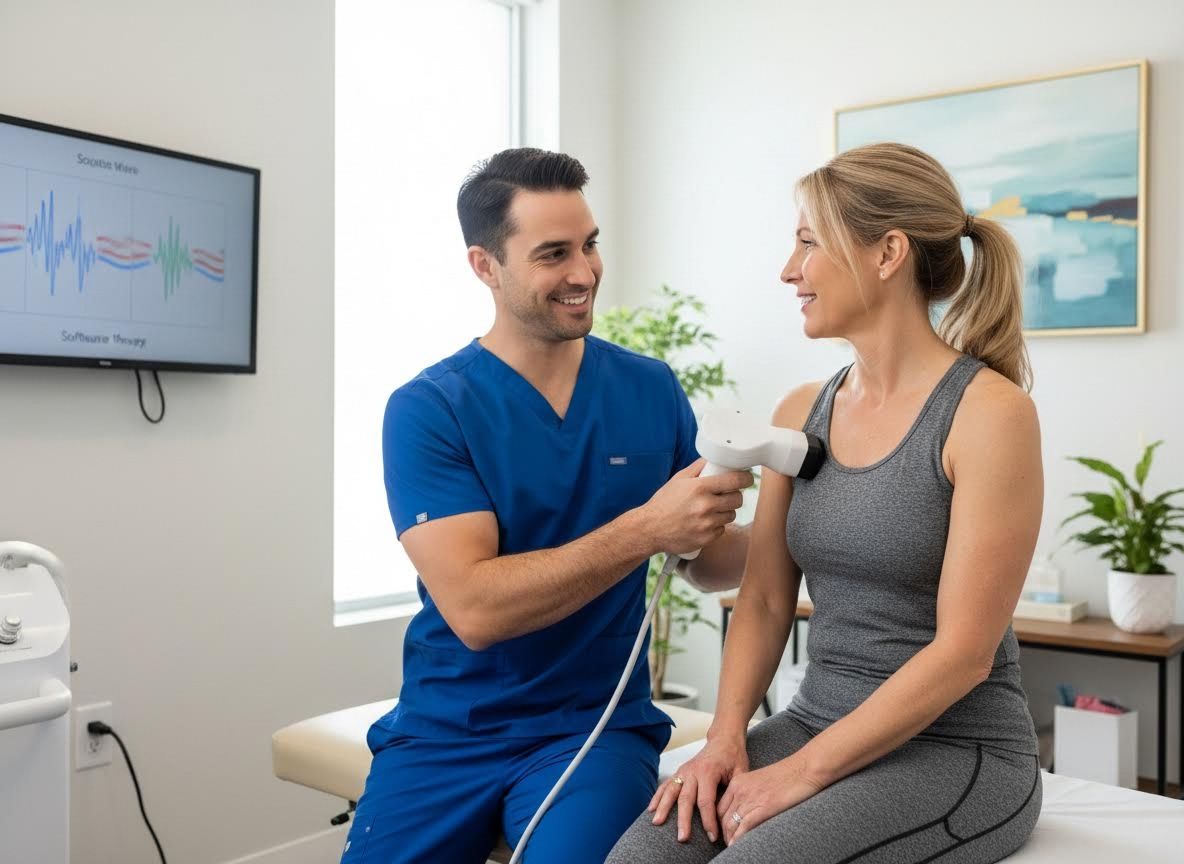
SoftWave Therapy uses acoustic waves delivered externally through the skin into targeted tissues.
These waves create mechanical stimulation designed to encourage biological responses associated with the body’s natural repair processes.
Research involving extracorporeal shock wave therapy has investigated effects involving:
Local circulation
Collagen remodeling
New blood vessel formation
Cellular responses associated with tissue repair
Pain signaling
Shock wave therapy has been studied for several chronic tendon-related conditions. However, treatment suitability and individual results vary.
Why Consider SoftWave Therapy for Persistent Elbow Pain?
For appropriate patients, SoftWave Therapy provides a conservative option that doesn’t require surgery or injections.
Treatment is:
Non-invasive
Drug-free
Performed in-office
Targeted to specific areas
Compatible with rehabilitation
Designed to support the body’s natural repair processes
The goal isn’t to promise an instant fix.
Instead, SoftWave Therapy may be incorporated into a larger plan designed to improve function and gradually increase the elbow’s ability to tolerate activity.
You Don’t Need to Be a Golfer
Golfer’s elbow can affect nearly anyone who repeatedly uses their hands and forearms.
Weightlifters
Rows, pull-ups, curls, deadlifts, and other exercises require significant gripping.
Golfers
Repeated swinging and gripping can place considerable demands on the forearm tendons.
Construction and Trade Workers
Tools, repetitive lifting, drilling, gripping, and manual work can repeatedly stress the elbow.
Climbers
Rock climbing and indoor climbing require significant grip and forearm strength.
Gardeners
Digging, pruning, carrying, and repetitive hand movements can also aggravate the area.
Treatment should be designed around the activities you actually need to return to.
SoftWave Therapy and Rehabilitation
SoftWave Therapy may be one component of care, but restoring strength is often important when dealing with tendon-related problems.
Depending on your evaluation, rehabilitation may include:
Forearm strengthening
Progressive tendon loading
Grip exercises
Wrist strengthening
Shoulder strengthening
Mobility exercises
Activity modification
SoftWave Therapy
Chiropractic care
The objective is to progressively prepare the tendon for the demands you place on it.
Should You Stop Using Your Arm?
Not necessarily.
Completely avoiding movement isn’t always required.
Instead, your provider may recommend temporarily reducing or modifying activities that repeatedly aggravate symptoms.
For a golfer, that could mean temporarily changing playing frequency.
For a weightlifter, it might involve modifying certain pulling exercises.
For someone working a physical job, treatment may focus on changing how certain repetitive tasks are performed while rebuilding strength.
The right strategy depends on your individual condition.
What Happens During a SoftWave Session?
Your provider will first evaluate your elbow and determine whether SoftWave Therapy is appropriate.
If recommended:
Conductive gel is applied to the treatment area.
A handheld applicator delivers acoustic waves through the skin.
Specific areas may feel more sensitive during treatment.
Your provider monitors your response.
Additional rehabilitation recommendations may be provided.
SoftWave Therapy does not require surgical incisions.
Stop Letting Your Grip Determine What You Can Do
Elbow problems can be surprisingly limiting.
Opening a jar hurts.
Picking up a dumbbell hurts.
Carrying groceries hurts.
Swinging a golf club hurts.
Even shaking someone’s hand can become uncomfortable.
If your elbow symptoms are beginning to influence everyday decisions, having the problem evaluated may be more productive than continually waiting for it to disappear.
When Should Elbow Pain Be Evaluated?
Consider scheduling an evaluation if:
Symptoms have persisted for several weeks
Gripping consistently causes discomfort
Your grip feels weaker
Pain returns whenever you exercise
Golf has become uncomfortable
Work activities aggravate your elbow
Rest only provides temporary improvement
You’ve started avoiding activities because of pain
Sudden severe pain, substantial swelling, deformity, significant weakness, numbness, or symptoms following major trauma should receive prompt medical evaluation.
Frequently Asked Questions
Is golfer’s elbow the same as tennis elbow?
No. They affect different areas around the elbow. Golfer’s elbow typically involves the inside of the elbow, while tennis elbow commonly affects the outside.
Can SoftWave Therapy help golfer’s elbow?
Extracorporeal shock wave therapy has been studied for chronic tendon-related conditions around the elbow. A provider should evaluate your specific symptoms to determine whether it may be appropriate.
Does SoftWave Therapy involve injections?
No. Acoustic waves are delivered externally through the skin.
Can I continue working out?
Possibly. Your provider may recommend modifying certain exercises while maintaining other appropriate activities.
How many SoftWave sessions are needed?
Treatment recommendations vary according to your diagnosis, symptom duration, activity level, health history, and response to treatment.
Golfer’s Elbow Treatment in Loveland, Colorado
Persistent elbow pain doesn’t have to become something you simply work around forever.
If you’re searching for SoftWave Therapy for golfer’s elbow in Loveland, Colorado, an evaluation can help determine what’s contributing to your symptoms and whether SoftWave Therapy may fit into your treatment plan.
Whether your goal is getting back on the golf course, returning to the gym, climbing again, working comfortably, or simply carrying groceries without thinking about your elbow, treatment should be built around helping you return to the activities that matter.
Schedule Your SoftWave Consultation in Loveland
If elbow discomfort keeps returning every time you grip, lift, swing, or train, it may be time to have it evaluated.
Schedule a consultation at our Loveland clinic to explore your conservative treatment options and determine whether SoftWave Therapy may be appropriate for you.
Strengthen your grip. Restore your movement. Get back to doing what you love.