When a Nagging Injury Starts Controlling Your Workouts
You know the feeling.
Your shoulder hurts every time you bench press. Your elbow starts bothering you during curls. Your knee feels fine until leg day. Maybe your Achilles or heel has become the reason you keep skipping certain exercises.
At first, you train around it.
Then you reduce the weight.
Eventually, you're designing your entire workout around avoiding one painful area.
For active adults searching for SoftWave Therapy for weightlifting injuries in Loveland, Colorado, SoftWave Therapy may be considered as part of a non-invasive treatment and rehabilitation plan.
The goal isn't simply getting you through your next workout.
It's helping you build toward training consistently again.
Why Do Weightlifting Injuries Happen?
Resistance training intentionally places stress on muscles, tendons, joints, and connective tissues.
That's part of how your body adapts and becomes stronger.
Problems can develop, however, when the demands placed on a particular area exceed its current ability to recover and adapt.
Potential contributing factors include:
Rapid increases in training volume
Sudden increases in weight
Repetitive movements
Insufficient recovery
Previous injuries
Limited mobility
Poor load management
Changes in exercise selection
Training through persistent pain
Not every gym-related injury is caused by poor technique. Sometimes the issue is simply too much load, volume, or frequency for a particular tissue at that time.
What Is SoftWave Therapy?
SoftWave Therapy uses acoustic waves delivered externally through the skin into targeted tissues.
The mechanical stimulation produced by these waves is designed to encourage biological responses associated with natural tissue repair.
Research involving extracorporeal shock wave therapy has investigated effects involving:
Local circulation
Collagen remodeling
New blood vessel formation
Cellular responses associated with tissue repair
Pain signaling
Shock wave therapy has been studied for several chronic tendon and musculoskeletal conditions, although treatment recommendations and individual outcomes vary.
Common Weightlifting Problems
Shoulder Pain
Bench pressing, overhead pressing, lateral raises, dips, and other upper-body movements place significant demands on the shoulder.
Persistent shoulder pain should be evaluated rather than continually trained through.
Elbow Tendon Pain
Pull-ups, curls, rows, presses, and repetitive gripping can contribute to irritation around the elbow.
Both tennis elbow and golfer's elbow can affect lifters.
Patellar Tendon Pain
Squats, lunges, jumping, and other lower-body exercises repeatedly load structures around the knee.
Achilles Tendon Problems
Running, sled work, jumping, calf training, and other explosive movements can place considerable stress on the Achilles tendon.
Plantar Fascia and Heel Pain
Heel discomfort can interfere with squatting, deadlifting, cardio, and simply walking around the gym.
Different problems require different treatment strategies, making an accurate evaluation important.
Why Lifters May Consider SoftWave Therapy
For appropriate patients, SoftWave Therapy offers several characteristics that fit well within an active lifestyle.
It's:
Non-invasive
Drug-free
Performed in-office
Free from surgical incisions
Free from injections
Compatible with rehabilitation
Targeted to specific areas
SoftWave Therapy isn't intended to replace appropriate strength and rehabilitation work.
Instead, it may become another tool within your overall recovery strategy.
Should You Completely Stop Lifting?
Not necessarily.
Depending on the injury, you may be able to continue training while temporarily modifying specific exercises, loads, ranges of motion, or training volume.
For example, your rehabilitation strategy may involve:
Reducing aggravating movements
Changing exercise selection
Temporarily decreasing load
Strengthening surrounding muscles
Progressive tendon loading
Improving mobility
Gradually reintroducing movements
The objective is to maintain as much appropriate activity as possible while giving the affected area an opportunity to recover.
Stop Testing the Injury Every Workout
One common mistake is constantly "checking" whether an injury is better.
Your shoulder hurts during bench press.
You take three days off.
Then you immediately bench again to see if it still hurts.
It does.
You wait another few days and test it again.
This can become a frustrating cycle.
Instead of repeatedly testing the problem, it may be more productive to create a structured progression back toward the movement.
SoftWave Therapy + Chiropractic + Rehabilitation
Musculoskeletal problems can involve multiple factors.
That's why some treatment programs combine SoftWave Therapy with other conservative approaches.
Depending on your evaluation, your plan may include:
SoftWave Therapy
Chiropractic care
Strengthening
Mobility work
Progressive loading
Soft tissue techniques
Movement modifications
At-home exercises
Treatment should ultimately be built around your condition and goals.
What Happens During a SoftWave Session?
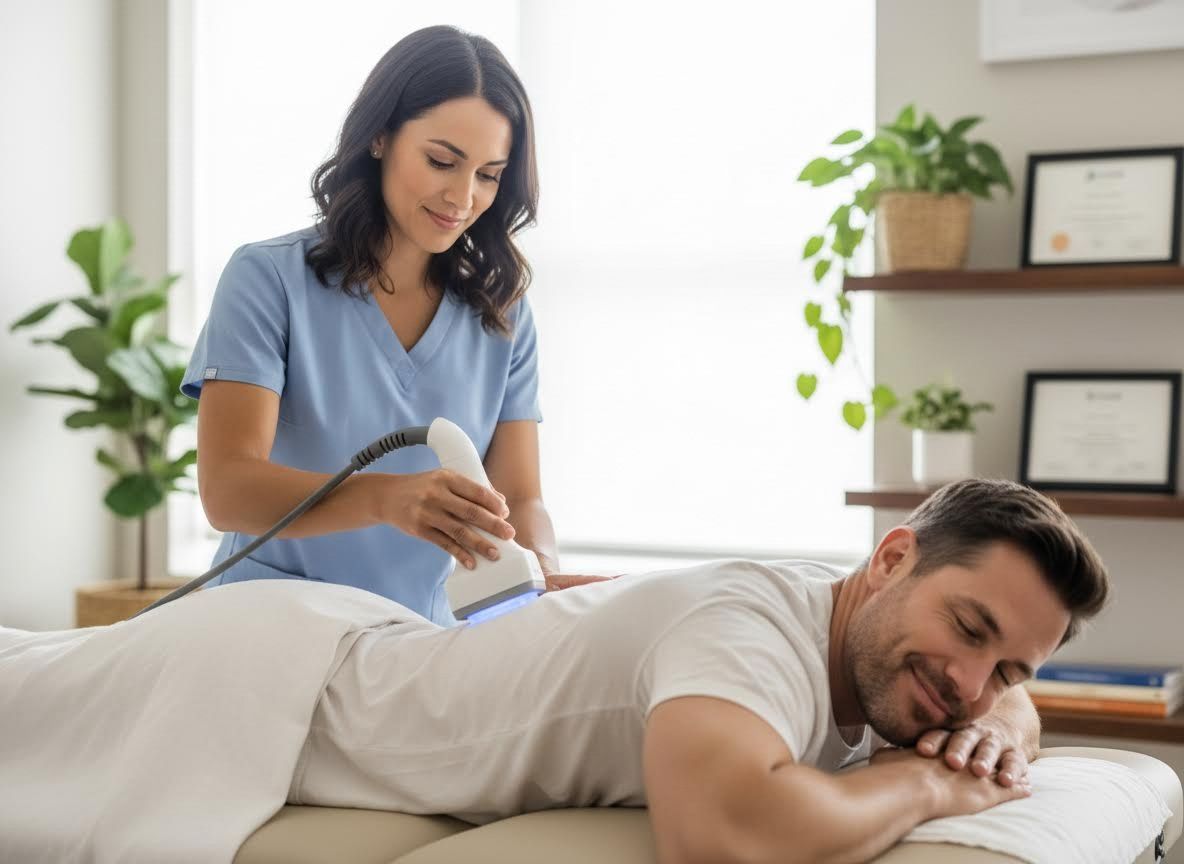
If your provider determines SoftWave Therapy is appropriate, treatment is performed using a handheld applicator.
Conductive gel is applied before acoustic waves are delivered through the skin into targeted tissues.
Certain areas may feel more sensitive during treatment.
Your provider monitors your response and may provide additional recommendations for training and rehabilitation.
Recovery Isn't the Same as Doing Nothing
When lifters hear "recovery," they sometimes assume it means sitting around and waiting.
But rehabilitation often involves movement.
The right exercises performed at an appropriate intensity can help progressively prepare tissues for greater demands.
Your provider may gradually work toward movements that resemble the exercises you want to return to.
The end goal might be:
Pressing without constantly worrying about your shoulder.
Squatting confidently again.
Getting through pull day without elbow discomfort.
Returning to your normal training schedule.
Your treatment plan should reflect those goals.
When Should You Have a Gym Injury Evaluated?
Consider scheduling an evaluation if:
Pain has persisted for several weeks
The same exercise consistently causes symptoms
You've significantly reduced training because of pain
An old injury keeps returning
You're losing strength because you're avoiding movements
Rest provides relief but symptoms return during training
You're constantly changing workouts because something hurts
Severe pain, major swelling, deformity, sudden weakness, inability to use the affected area, or symptoms following significant trauma should receive prompt medical attention.
Frequently Asked Questions
Can SoftWave Therapy help tendon injuries from lifting?
Extracorporeal shock wave therapy has been studied for several chronic tendon-related conditions. Whether it's appropriate depends on the specific diagnosis and individual patient.
Can I lift weights during SoftWave treatment?
Possibly. Your provider may recommend continuing certain exercises while temporarily modifying others.
Does SoftWave Therapy involve needles?
No. Treatment is delivered externally through the skin.
How many SoftWave sessions will I need?
Treatment recommendations vary according to the condition, how long symptoms have existed, your activity level, and your response to care.
SoftWave Therapy for Weightlifters in Loveland, Colorado
You put a lot of work into building strength.
A nagging injury shouldn't automatically mean giving up the gym.
If you're searching for SoftWave Therapy for weightlifting injuries in Loveland, Colorado, a comprehensive evaluation can help identify what's contributing to your symptoms and determine whether SoftWave Therapy should be incorporated into your recovery program.
The objective isn't simply to make something temporarily feel better.
It's to help you work toward being strong enough, mobile enough, and confident enough to train again.
Schedule a SoftWave Consultation in Loveland
If you've spent weeks modifying your workouts because of the same shoulder, elbow, knee, Achilles, or heel problem, consider having it evaluated.
Schedule a consultation at our Loveland clinic to explore your conservative treatment options and determine whether SoftWave Therapy may be appropriate for you.
Recover with a plan. Rebuild your strength. Get back under the bar.